Whoberley Hall Primary School
Whoberley Hall Curriculum Planning
We have carefully mapped our curriculum to ensure that every year provides a rich, varied and purposeful sequence of learning that stimulates children’s natural curiosity. At the heart of our curriculum is a knowledge-rich approach, where carefully selected knowledge and vocabulary provide the foundations upon which children can develop skills, make connections and deepen their understanding.
Our curriculum is aligned with the National Curriculum objectives, which are carefully broken down into progressive milestones to ensure a broad, balanced and ambitious curriculum for all pupils. Each topic is designed to engage children and provide opportunities to develop knowledge, strengthen fundamental skills, introduce new concepts and inspire curiosity. Learning is deliberately sequenced so that new knowledge and skills build upon what has been taught previously, enabling pupils to make meaningful connections and develop increasingly sophisticated understanding over time.
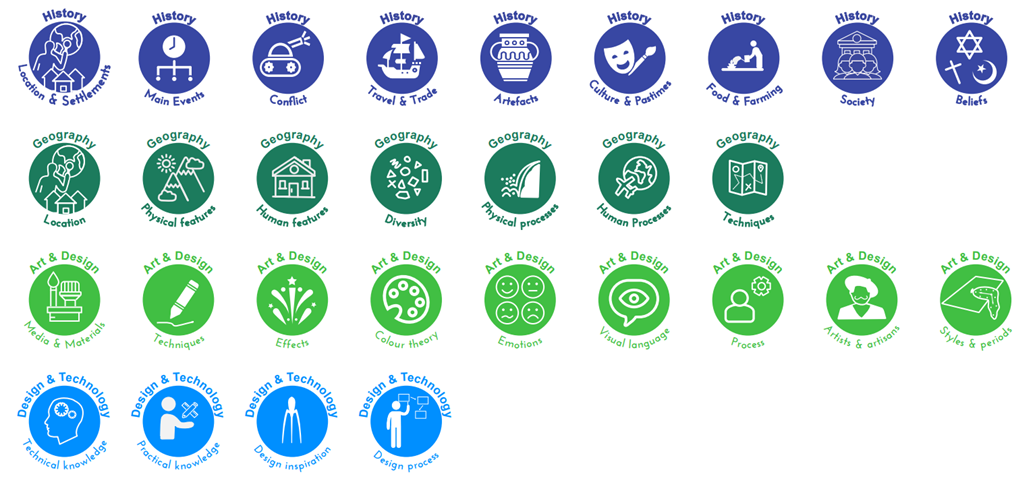
We recognise that learning becomes more secure when new knowledge is connected to what pupils already know. We therefore support children to develop schemas – interconnected networks of knowledge that grow and become increasingly sophisticated over time. Our use of curriculum lenses across the school provides a consistent way for pupils to identify these connections within and across subjects.
For example, exploring the ‘Conflict’ lens during a Year 5 History lesson on the Second World War enables pupils to connect their learning to previous historical periods where conflict has been explored. Each new encounter adds to and deepens their existing understanding of the concept. Similarly, in Geography, revisiting the ‘Physical Processes’ lens during Year 1 learning about seasonal change and again in Year 4 when exploring extreme weather helps pupils to connect new learning to what they already understand about physical geography.
Through this approach, our foundation subjects are not taught as isolated units of knowledge. Instead, themes and concepts recur deliberately across the curriculum, allowing pupils to revisit, connect and build upon prior learning. While each lesson has its own clear focus and learning objective, it also contributes to a wider curriculum narrative, enabling children to see how their learning connects, develops and becomes increasingly meaningful over time.
Ultimately, our curriculum is designed so that children do not simply learn more, but know more, remember more and understand more, developing a rich and connected body of knowledge that they can draw upon throughout their education and beyond.